Thursday, 6 March 2014

Gaining Wisdom From Experience (and Being Starstruck!)

Whatever area of life you want to excel at – creative, mental, physical, spiritual - it can be super helpful to get advice, hints, tips and motivation from people who are ahead of you on the journey.

As I’ve mentioned before, Cressida Cowell is one of my writing heroines, so I was very excited to discover that she was doing a talk (with her friend and fellow successful author, Lauren Child) as part of the Imagine Children’s Festival when we were down in London recently.

It was really enjoyable and full of helpful writing insights and advice.  It was also easy to feel inferior, inept and ineffective :-/  Both Cressida and Lauren are so much further along the path that I want to go down.  Rather than being jealous of their success though, I think I was more jealous of the amount they’ve been able to write.  I can’t change the fact that I’ve let my writing dream slumber for so long and I can never guarantee how much success I might have, but at least I can do something about writing as much as I possibly can from now on.

There’s a lot of life situations where it’s possible to be discouraged and encouraged simultaneously.  It’s up to us to decide which emotion we’re gonna let preside and determine our course of action.  I’ve been battling for weeks with discouragement and so I’m making a conscious determined effort to focus on the encouraging provocation of their talk.

My favourite nuggets of information/inspiration were:

- don’t necessarily listen to advice from “experts”.  Lauren was advised by some tutors not to write humour, as she wasn’t funny (she writes humour, for those of you who haven’t come across Charlie & Lola, Clarice Bean or Ruby Redfort).

- failure is an important part of success.  It makes you more determined and persistent.

- persistence is essential in the writing business.  You can learn it first from agent rejections! 

- writing is about *feeling*.  Channel those feelings and memories that you felt deeply as a child.

- a great hero needs a great journey!

I learnt some practical and professional lessons too at the book signing afterwards (stored for future reference, just in case I ever get to the point of doing an author’s book signing one day!).  Cressida asked each person if they had a question, while she was signing their books – a great idea for kids who are feeling a bit shy about asking something.  She chatted away and had a photo with everyone who wanted one.  It meant the queue took a longer time to go down, but everyone felt that they got some special time with her, rather than being rushed through on a book signing conveyor belt.


J and I got our photo with her, naturally.  It always feels a bit cheesy, but I was keen to rub up against her arm and hope that some of her writing genius and success rubbed off onto me :-)

It isn't just at talks and face-to-face events that you can benefit from the wisdom and encouragement of potential role models.  Books, videos, Twitter, Facebook, blogs, etc. provide a myriad opportunities to access it too.  Just make sure that you choose the people you listen to wisely, especially if you’re going to be letting them influence your life in any way!

Tuesday, 11 February 2014

Rejection Reality

I had very little idea when I started on my writing journey, how pertinent a metaphor “journey” was actually going to be.

As I trundle along, I constantly discover twists and turns, as well as the fact that a point which looks kinda close is actually a helluva lot further away than it seems.  Sometimes the road is smooth (like with my writing surge last November) and sometimes it’s bumpy (like with the agent rejections, or the frequent discouraging thoughts that tell me I’m a crap writer and there’s no point bothering).


After posting my last blog, I started wondering how many people would feel sorry for me because of the rejections, or think that I’m obviously not a “good enough” writer to get published (which may be true!). 

A lot of people have the impression that you write a book and then get it published.  That couldn’t be further from the truth.  Writing is a very loooooong path, with a gazillion more hurdles than you would ever imagine.  I’ve blogged about various ones in the past, will undoubtedly blog about more in the future, but for now I just wanted to bring some perspective to my agent rejections.

Being rejected is a completely normal - even expected - experience for a writer. 

The fact that JK Rowling was rejected by TWELVE publishers before one accepted Harry Potter is quite well-known.  Apparently many of them felt that boarding school stories were old hat!  I’ve often wondered how those editors live with themselves!  It’s gotta be pretty gutting to know you passed up on one of the biggest literary phenomena ever :-/

I also found out last week that although Roald Dahl’s “Charlie and the Chocolate Factory” was published in America in 1964, it took 3 more years to convince a UK publisher to take it on.  You'd have to be blind or illiterate not to see how amazing that story is, surely?!

A friend of mine was accepted by an agent last year, having had about 8 rejections before that.  The thing that really opened my eyes in this situation was that he knew, or had at least met, all/most of those agents.  I’m sure that with that extra level of knowledge and connection (which I don’t have), he would have first approached the ones he felt would best like his books and be the right fit relationally to work with.  Yet it STILL took several attempts to find the “one”.

Submitting your work to an agent isn’t like applying for a job.  It’s like sending a speculative application to a company you want to work for, without having much of an idea whether or not they’re wanting to take on someone like you at that moment (or ever!).

Taking the right story, at the right time, to the right person, is an incredible hurdle and one that writers are usually not aware of when they first start writing.  There are so many people trying to do it too, that agents are often overwhelmed by manuscripts.

It could be massively off-putting.  Some days it IS massively off-putting.  But it cannot stop me, you or anyone else who dreams of being a writer to stop writing (or not to start).  As I was so fantastically reminded by this timely blog post from Jeff Goins a few weeks ago, writers shouldn't write to be published.  We have to just write for the love of writing.  If we do that, then what comes out of our fingers and imaginations is likely to be worth reading…and therefore publishing.  If we write to be published then we’ll be listening more to the crowd and less to the Muse, and will be constrained by real and imagined factors.  Our work won’t have the spark, vibrancy and originality it should.  And it definitely won’t be a fun experience.

So, I’m gonna keep on writing, just for the sheer enjoyment of it…and no number of rejections are going to stop me.  I might need to develop and improve my writing ability.  I might need to write a different story, in a different genre, for a different audience.  But perhaps one day, just perhaps, I might successfully jump the agent hurdle, negotiate the publisher obstacle, and you’ll be able to read some of the work I’ll have been blogging about for years :-)

Monday, 27 January 2014

Rejection and Re-evaluation

SO sorry for the loooong delay in posting on this blog.  I spent December travelling around Australia and New Zealand which was amazing but very distracting :-)  My lack of blogging is symptomatic of my lack of writing in general, both of which I’m attempting to get back on course now I’ve had to return to “real” life!

I haven’t told you this yet, but I submitted B4 (my kids’ book) to three agents back in October.

It was one of the most scary things I’ve ever done.  My heart raced for several hours and I felt nauseous.

It was hard work too.  Making sure the first few chapters of the manuscript were as polished as possible was only the first step and that was a long first step!  A manuscript will never feel completely finished and perfect, so deciding when it was good enough and time to stop tweaking was tough.  On top of that I then had to write a synopsis (always easier said than done) and a covering letter. 

For one agent I had to submit a CV as well.  Seriously?!  I haven't updated my CV for years so it took aaaages.  I was suddenly more relieved than I’ve ever been to be able to say that I have a degree in English Lit and Lang - hopefully it gives me a little writerly kudos!

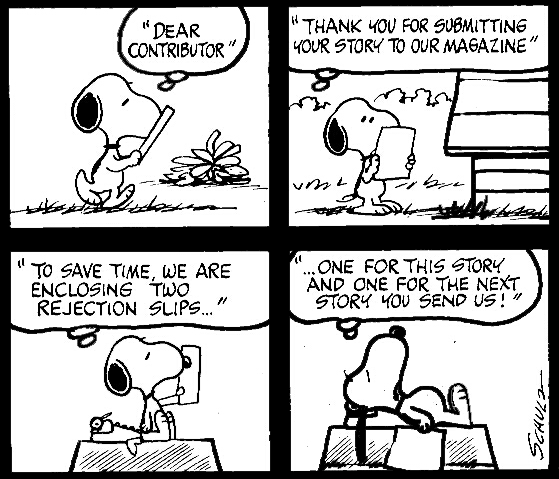
The first agent took just over a week to reply...with a rejection.  Allegedly rejections are a “badge of honour” for writers.  I don’t quite get it.  The only positive thing about a rejection is it shows that I actually managed to complete a manuscript and submit it. It hurts your ego, hopes and dreams for a time.  That’s only natural.

Bizarrely though, I found myself feeling seriously relieved too.  Eh? I thought.  Then it dawned on me that if an agent was interested in B4 and picked it up, I would probably be writing it for the next 3-5 years, as it’s the first of a potential series.  Much as I love Ben and Ned – and I do! – I’m keen to try my hand at other writing too, notably YA fiction and screenwriting.  I realised that I wasn’t ready to get swept up in the rollercoaster of publication for this book and its sequels just yet.

Still I had two more agents to wait to hear back from and I was torn between wanting a yes (for my ego and to further the dream) and a no (so I gained time to write some different stuff before pushing on with B4).

The second rejection came a couple of weeks later.  I was truly relieved about that one, as it was from a big agency that frankly felt too big and impersonal for me.  However, it was a painful rejection and very differently worded to the first one I’d had. They “unfortunately…did not feel enthusiastic enough about it [B4] to take this further.”  Ouch!  That just says “we don’t like your work” or “it’s rubbish”.  Much more personal and critical.  And crushing.


I was fascinated by the difference in rejection messages.  The first rejection had come from the agent who I’d always figured that they’d either be my best bet (coz they represent the writer of another kids series, the one I’d used as a bit of a benchmark for B4) or my worst bet (coz they already had that area on their list covered and didn’t want anyone similar).

Their rejection said that they had “decided it is not quite right for our list but we wish you all the very best in placing elsewhere.”  Nice gentle let down.  As well as massively revelatory about the world of agents.

When you submit to an agent, they are naturally gonna look at whether or not you’re a good writer and can tell a story well.  But there’s way more to it than that.  Agents are business people, looking for clients that will make them money.  They don’t just want any old good writer on their lists, but are looking to specialise in certain areas or fill any gaps in their current list.  Even if you’re a great writer with a fantastic story, you may get rejected many times until you find the agent who really “gets” you and your story, and whose list you’ll fit into.

Without a crystal ball, you just have to keep submitting to agents, stacking up the rejections (sorry, badges of honour) and hope that you find “the right one” one day.

The third rejection – yes, I got three nos – took ages to come, longer than the company’s stated response time.  Perhaps I should have rejected them on that basis?!  By this time I didn’t mind if it was a yes, as I’d already progressed well with my YA writing.  Their let-down was encouraging and kind though – “I did not feel it would be right for my list and therefore I am unable to offer you representation.  I am sorry not to be writing with better news, but I hope this response will not discourage you. I wish you all the best with your writing.” 

Even if that is just what she says to everyone, I definitely preferred receiving it to the second agent’s brush-off.  I’d happily submit future work to this agent (and possibly the first), but I won’t be sending anything to the second agent ever again!

So, what’s the future for B4 now?  I’m putting it aside for the moment - not because I'm demoralised but in order to focus on the other areas of writing I’ve mentioned.  I’m already aware of some revisions I want to do on it though – making it more bouncy and pacey, tweaking a couple of plot details – and I’ll attempt that sometime later this year.  Then I’ll probably submit to more agents and perhaps look to enter it in some competitions.  And toughen myself up in preparation for future rejections...

Sunday, 1 December 2013

The Vomit Draft

Too many people don’t start writing – or give up on their writing – because they think that what comes out won’t be “good enough” or what they do manage to get onto paper or screen isn’t quite what they expected.  But here’s a massive writerly not-such-a-secret.  The first draft is usually crap!

I initially became aware of “Shitty First Drafts” thanks to Anne Lamott in her excellent book on writing “Bird By Bird”.  This idea was reinforced at Swanwick this year when James Moran (a successful screenwriter) talked about Draft Zero or the Vomit Draft.  Melvin Burgess at Arvon, also referred to a similar phenomenon.

What comes out when you first start writing a book is just raw material.  But it’s essential to get it out, so that it’s there, ready to be crafted and improved.  “Shitty first drafts” is an obvious expression, but James Moran’s Draft Zero is all the more revealing and informative.  The first draft is often so awful that it can’t even be counted as a first draft.  Draft Zero is for no one’s eyes other than your own.  The first draft usually isn’t either.

The analogy I use when thinking about my writing process is comparing it to making a clay pot.  The first draft is just throwing a lump of clay on the potter’s wheel.  The second draft is when it starts to take some shape.  Subsequent drafts add more detail and definition.

And the Vomit Draft.  Sounds a bit gross, right?  I’ll try not to take the analogy too far, in case you’re feeling a bit queasy :-)  Basically, it means you just spew out the story, the plot, the events, the characters, without a massive amount of editing or even care, as you go.

You don’t worry if it seems long-winded.  You ignore concerns about it not being the most perfectly formed piece of prose or a short-hand clichéd description.  You just write.  You get the story, the plot, the characters, the action, out onto the page.  Perfecting it comes later…in the endless editing.

Having finished B4 and started submitting it to agents (more on that next time), in the last month I’ve found myself writing the vomit draft for a new story.  Despite to-ing and fro-ing over several weeks about which YA story to pursue, I have finally settled on CAF.  Wanting to use what I learnt on the Arvon course to the max and realising that CAF is a massive story (potentially trilogy), I was keen to crack on with it as quickly as possible.  So, seeing as it was perfect timing, I decided to use the principles of November’s National Novel Writing Month (NaNoWriMo) to help me.

The idea of this initiative is exactly that of a vomit draft – you write 50,000 words of a novel in a month (roughly 1,667 words a day).  The emphasis is on quantity, not quality.  You just need to get words on the page.

Choosing an image for this post was challenging - be grateful I settled on this one ;-)

I haven’t done NaNoWriMo officially as I didn’t want to upload my work to the site at the end of the month and I already had 10,000 words of CAF (although I didn’t get going until a few days in, but you’re supposed to start from nothing).  Instead I just set myself the target of writing 1,500 words a day (45,000 words by the end of November).

Now, I’ll be honest with you.  I didn’t think I’d be able to do it.  Not, at least, without having to play massive catch-up on my scheduled writing days.  I was also dubious because there was so much that I still didn’t know about the story, and I’d always felt that I needed to before I could possibly start writing it.

But, do you know what?  It’s been fan-flipping-tastic!  I HAVE written 1,500 most days (and always caught up within a day when I haven’t).  Scenes, characters, relationships and conversations have flowed and developed easily as I’ve typed.  Yesterday, at the official end of NaNoWriMo, I'm stoked to be able to tell you that I have indeed hit my self-imposed target of 45,000 words, hurray :-)

Taking the pressure off myself to write something “good” has been highly beneficial.  Sometimes the prose hasn’t been very good, but sometimes it actually has!  Everything I've written has helped the story progress in my thinking, regardless of whether or not it makes the final cut.  And in that I think I’m a better editor than writer, at least I now have something to work with.

When I stop writing, that is.  Which isn’t gonna be for awhile.  I have a huge amount more to explore in this story and potentially another 200,000+ words to write!  Having had such a positive result with them, I’m going to work to NaNoWriMo targets again in January.  In the words of the great philosopher Dory, I’ll just keep spewing, just keep spewing, spewing, spewing…. ;-)

Friday, 22 November 2013

Awful Arrogant Authors

Talking with and listening to other writers is one of the most valuable and enjoyable things I do on my writing journey.  I’ve already learnt so much from them, even from passing comments or throwaway remarks.

For some reason beyond my logical comprehension, I had an expectation that authors – especially published ones - would be egotistical, superior literary gods who have perfect prose flowing out of their fingertips at the slightest provocation and look down on anyone who isn’t as miraculously gifted.

Having now met a growing number of writers, I haven’t actually met even one awful, arrogant author…yet.  Because we’re not in direct competition, we’re generally nice to and encouraging of each other.  Even if two writers were writing about the same topic, the books they produce will be markedly different, as no one has the exact same voice or viewpoint as anyone else.  Everyone’s work is unique.  Writing is nothing like an exam where there are right answers and we can compare our marks and grades.  Good work sometimes doesn’t get published and bad work sometimes does!

The amazing authors I met at Arvon (not awful or arrogant in the slightest!)


It was when reading an interview with Harlan Coben earlier this year that I discovered that, like me, he swings from thinking his work is great to the next day thinking it sucks.  At Arvon, Lucy Christopher shared how stuck she’d sometimes got while writing “The Killing Woods” and had to walk around the Forest of Dean, as well as get a friend to write some music for her, to release the story.  Also, at Arvon, Meg Rosoff told us that she often gets caught between finishing one book and starting on a new one, with no ideas coming and no obvious way forward, sometimes for weeks (although she more than capably gets there in the end) :-)

Sharing our writerly struggles is unbelievably important.  Writing is a very isolated task – the majority of it done at home, on your own.  I often go whole (school hour) days without talking to anyone.  It’s far too easy to end up thinking that you’re the only person who ever faces certain difficulties or having certain struggles.

Other things we share can be more positive, like recommendations of useful books, courses or conferences.  I was encouraged to find out at Arvon (yes, “at Arvon” will be a repetitive phrase in my blog, definitely for weeks to come, possibly months, perhaps even years!) that my writing process is a lot like Melvin Burgess’s.  When we’re working on the first draft of a book, we both have key scenes in our heads which we write and then start to link them together.  I admire people who can write in a linear way, but that doesn’t appear to be my style and it was great to find out that I’m not completely odd in my preferred method!

Writers can also help you to tap into and understand unconscious thoughts more fully.  At Arvon, Meg Rosoff shared a dressage analogy about resonance - the art of the horse and rider working together in complete unity – and how that is also true in writing, when you suddenly connect with an idea and it starts going full flow, in perfect tune with the story.  It was useful, but one of my course mates, Dale, reiterated it the next day as a surfing analogy, which I understood a lot better having surfed before (but never having done dressage!).

To surf, there’s a lot of preparation, including checking the tide times (finding the right time), but if you’re ever gonna do it you actually have to get into the water.  There can be so many obstacles even when you get there – the wind taking the tops off waves so they’re not that good; it’s too cold to be enjoyable; there are too many people in way to get a good run.  But when you catch THE wave, then the triumph and exhilaration of the ride make it well worth the wait! 


It can be hard to find the right time to write and even when you do, the right words might not come, a character might be difficult or a plot twist not authentic and credible enough.  But on those days when it all starts to flow, wow!  The rest of the world falls away and literary magic happens on the page.  Those days make all the hard slog and the times when you write one word after another on the page just coz you have to worth it.  They are the practice waves that mean you’re there and you’re ready when the big one comes!  I’ve found this image really encouraging and a great motivator to get on and write every day, regardless of how well it goes.

The writing has been going splendiferously well recently though :-)  More on that next time…

Sunday, 10 November 2013

Sex, Drugs and Fairytales (more from Arvon!)

Something that had concerned me before going on the Writing for Young Adults Arvon course was the fact it was subtitled “Playing On The Edge”.  My heart sunk when I noticed that (after I’d paid!) and I was convinced that we were gonna be made to write about sex, drugs and rock ‘n’ roll the whole time. 

However, in the Plot workshop, scary Melvin (who wasn’t scary at all, in truth, but a really lovely guy!) got us deconstructing Jack and the Beanstalk by examining the different characters and their roles in the story.  Looking at magic beans and geese that lay golden eggs with the writer of gritty books like “Junk” and “Doing It”?  Who would have ever predicted that!  So much for my concerns :-)


We then had to plot a contemporary story using the plot of another fairytale as its framework.  My group’s reworked version of Snow White meets the Brownlee brothers was surprisingly good and definitely writable.  I was almost tempted to give it a try, but sadly there are other ideas that are calling to me more loudly at the moment.  “Nick a plot!” was Melvin’s brilliant summary advice at the end of the session!

One of the YA stories I’m developing is loosely based on another story and I have ideas about other possibilities too.  It’s a fantastic way to brainstorm plot ideas, even if you don’t end up using them.  If you’re not confident about plotting then it can also ensure that your story has a good structure, with the necessary rise and falls, twists and turns.  Lots of writers do it!

The final workshop of the week on Setting, with Lucy, was probably the most hotly anticipated.  In no way does that belittle the great teaching that Melvin gave us, but setting is difficult.  Lucy is much lauded for her incredible skills at not only bringing settings to life, but even making them an integral part of the story.

Fascinatingly – especially for someone like me, who starts a story with plot or theme ideas – Lucy always starts from the setting and looks for the story in it.  Her first book “Stolen” is set in the Australian Outback, her second “Flyaway” is based on a RSPB nature reserve, and her third book “The Killing Woods” is inspired primarily by the Forest of Dean, near where she lives.

One of my biggest problems with adult literature is how slowly it often moves along, especially when getting bogged down with long-winded description of surroundings.  Consequently, I’d come to the opinion that if a story is full of pace and action then setting needs to be more or less ignored.

Not so!  Done properly, setting can add tremendous depth to the action of a story and not detract from its pace at all.  I’d started to realise this fact when reading Lucy’s books, but it became blindingly obvious during the exercises in this session.  I found the idea of doing sensory sheets before writing a scene particularly useful – thinking about how everything looks, feels, smells, sounds and tastes – to fully embed yourself and your reader in the place.


Some of my fellow writers produced incredible pieces of writing in that session!  I didn’t, although that was because I was still processing this revelation and getting my head around writing in what was a very foreign way for me (being much more into the big picture, rather than the small detail).  However, later that day I applied my newfound skills and awareness to a scene in the story I was working on and was really pleased with what I produced.  So much so, that I was happy to read it out that evening at our end of course celebration evening, rather than run away and get an early train home, which I had seriously been considering doing up until that point!!

This learning was consolidated a couple of days later when I was on a long car journey with my family and we were listening to an Alex Rider audiobook.  With everything I’d learnt still prominent in my mind, I was paying close attention to the writing, as well as the story.  Alex always has a tumultuous roller-coaster ride of a time in these books and so I’d naturally assumed that there’d be little in the way of setting and description, as that would slow down the pace.

To my mahoosive surprise, I was wrong again!  Anthony Horowitz is a master of setting and description!!  The amount of detail he includes is amazing, yet it doesn’t disconnect you from the action, like it so easily could do, but actually takes you deeper into it.  My ears were just sucking it all in and I learnt a huge amount more.

Now I just have to translate all that learning into my own writing!

Saturday, 2 November 2013

White Stilettos and Nappy Nights

The most concentrated learning on my Arvon course naturally took place in the 3-hour morning workshops.  It was the opportunity to have successful and world-renowned writers like Melvin Burgess and Lucy Christopher as tutors that had originally attracted me to this course.  Far from disappointing my high expectations, they were exceptional in their teaching, encouragement and the incredible amount of time and energy they gave to us all in many different ways.  Gushing hyperbole again – I apologise but, in my defence, it’s entirely justified!

Workshop time (with thanks to Dorthe Andersen)

An essential aspect in most of our learning was re-connecting with our teen self, so that our written teen voice could be as authentic as possible.  Although adults write YA, you can’t let your “adult” voice speak.  The narrative has to sound like a teenager is speaking, especially if you’re writing in the 1st person.

Getting in touch with teen Mel again was an interesting one as I really didn’t enjoy my teenage for a number of reasons and have blocked out most of it from my memory.  I learnt a LOT from that time, but I ignore the actual experience as much as possible – life has got so much better since!

In Melvin’s first session on “Voice” we had to relive a teen experience and write about it from the point of view of another character involved in it.  With trepidation, I chose a situation when I was deliberately and unkindly betrayed by some “friends”.  Writing it from the main perpetrator’s POV was fascinating though, coz although I’d kinda understood why she’d done it, I’d never put myself in her position to think it through in detail before.  Reflecting on her possible motivations as though I was her, made me realise that I could have so easily acted the same way she had.  She certainly wouldn’t have thought that what she did was anywhere near as significant as it felt to me.  An incident that’s had serious emotional repercussions throughout my life suddenly seemed less of a big deal.  Unexpected result!

Melvin suggested that writing an autobiography of your teens can be a valuable way to remember that time, especially if you’ve repressed it – not for publishing (ever!) but as a personal exercise, which could have positive repercussions on YA writing.  I think I’ll give that a go!  It could be fun.  It’ll certainly be fascinating to see what comes up.  Melvin reckoned this exercise often unearths good memories from that time too, even if you initially remember it as just being crap.

Lucy’s workshop the next day – this time on the power of “Objects” – continued to help me open up more suppressed memories from my teenage.  Lucy asked us to draw a shoe we wore in our teens.  Initially I couldn’t recall a single thing that went on my feet during that time.  Then suddenly I remembered a much-longed-for pair of white stilettos.  They were so pointed that a kick from them would have done serious harm and made walking pretty painful too.  The heel was so sharp that I was constantly afraid of making a hole in carpets or wooden floors, or – even worse – standing on someone’s foot and doing them a serious injury!  They weren’t very high but they were my first pair of heels and I felt super grown-up and glamorous in them :-)  As I sketched them and jotted down notes about how I’d felt physically and emotionally when wearing them, I was instantly transported straight back to Nappy Night (an under-18s disco at the local nightclub) and numerous memories started flooding back!!

It was bizarre!  I could almost perfectly remember the layout of the place – the bar, the dance floor, the mixing desk, the seating, the lighting - even though it’s more than 20 years since I’ve been there.  I could vividly recall the feelings of hopefulness that whichever guy I fancied at the time would be there, heartaches and awkwardness after relationship splits or wrangles, self-esteem struggles comparing myself to the other seemingly slimmer and prettier girls there, as well as just enjoying the music and the fun of dancing.

They weren't as high as these, but you get the idea!

Who would have ever thought a pair of shoes could provide such powerful and easy access into long-forgotten memories?  I was so pleased with the piece of writing I produced from this exercise that I even volunteered to read it out in the session (having refused up until then)!!

Of course, none of this was supposed to be just a psychological therapy or regression exercise, beneficial though that might be!  If objects hold powerful memories or meanings for us, then that can also be true for our characters.  That workshop gave me lots of ideas for ways I could use objects in my writing.  I might even try and work those white stilettos in…